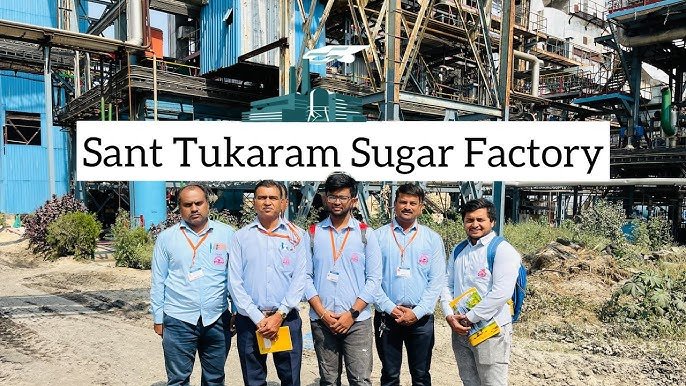

Sant Tukaram Sugar Factory is a major cooperative sugar factory located in Kasarsai-Darumbre, Pune district, Maharashtra. The facility is producing a high-capacity sugar plant capable of crushing 3,500 tons of cane per day. It was registered in 1990 and commenced operations in the 1998-1999 crushing season.
Details about the Shri Vithoda Alias Nanasaheb!
Shri Viduraji Vithoba, Alias Nanasaheb, is a visionary leader who has decided to dedicate his life to agriculture, industry, and sports in Maharashtra. He is a social activist born in Kasarsai Daruumbre, where he witnessed the hardship of rural masses. He completed his B.Com degree from Pune University. He started his career as a teacher and later became involved in various social movements.
History and origin!
The Sant Tukaram sugar factory was registered on 22nd May 1990. The factory was founded by the social and political leader Shri Viduraji Vithoba. The factory was established to uplift the hilly and historically underdeveloped agrarian landscape of Pune.
Know about the factory infrastructure along with the production profile!
The factory operates on a semi-electric driven configuration. It uses the double sulphitation method to produce high-grade commercial sugar. The factory has been operating for three decades and has expanded systematically to scale up regional output.
Crushing capacity
Originally, the plant was producing 2,500 tonnes of cane per day. Later, the figure reached 3,500 tonnes of cane per day.
Operational footprint
The facility covers 461 villages across the Mulshi, Khed, Haveli, Maval, and Shirur tahsils.
The facility has a sprawling membership base of more than 22,000 farmers providing direct employment opportunities to hundreds of thousands of workers. The facility is equipped with advanced machinery to ensure maximum efficiency. All processes, from juice extraction to cutting and crushing, boiling, and packaging, are completed with advanced machinery.
Sustainable co-generation!
The Sant Tukaram Sugar Factory is highly regarded for its work towards green, sustainable industrial practices. In 2015-2016, the facility expanded its infrastructure by commissioning a 15MW plant. Instead of discarding the fibrous byproduct generated after juice extraction, the factory utilises it as biomass fuel in boilers.
During the process, both electricity and steam are produced. The generated electricity can be used to run the factory’s heavy machinery, while the remaining electricity is sold back to the state power grid, supporting the local energy supply. Furthermore, the ash produced by the factory’s combustion is converted into organic fertilizer to promote sustainable farming for local communities. This is how the factory is playing an important role in sustainability.
Socio-economic impact along with cane development!
The factory is not just an industrial facility; it also works as an agricultural development centre. Initially, the factory struggles to secure enough local sugarcane; therefore, it has to be transported from outside areas. Therefore, to address the problem, management implemented a sugar development program in the area, providing the necessary support to farmers. They have provided high-quality seeds, financial subsidies, and ergonomic support for the farm, enabling sufficient sugarcane to be produced in the local areas, supporting local communities.
Conclusion!
At first, the Sant Tukaram sugar factory was established to support the rural populace in Pune, but later it evolved into a multifaceted agro-industrial enterprise. The industry has embraced sustainable practices while supporting local communities, thereby improving the economic stability of thousands of farmers.