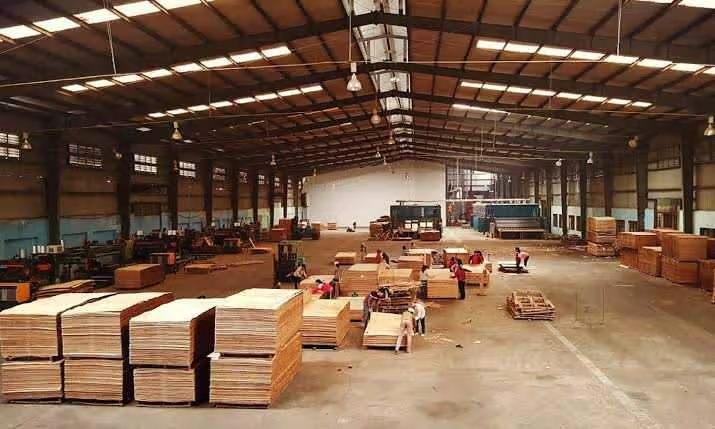

A plywood factory turns raw timber logs into versatile and durable engineered wood panels. First of all, timber is peeled into veneers and bonded cross-grain with adhesives. For bonding purposes, intense heat and pressure are applied. Plywood factory creates structural material which is crucial for modern Construction, interior design and cabinetry.
Process of log preparation and peeling!
The plywood production journey starts with sourcing plantation timber like poplar or eucalyptus. The timber is carefully debarked and cut into cylindrical blocks. Later, these blocks are soaked in hot water to soften the wood fibres. Steaming can be used for softening purposes.
Once they are conditioned well, these blocks are mounted on heavy-duty industrial lathes. When the log spins against a sharp razor blade, the wood is peeled into continuous and thin ribbons of wood veneers. These continuous ribbons are then clipped while keeping the standard width. Later, they run through an industrial dryer so moisture levels can be reduced or minimised.
Glueing and layup!
Once the wood veneers are dried, the veneer sheets are categorised as face/back piles or core piles. Automated layup machines are used to stack the veneers with alternating grain directions. The hallmark of plywood engineering is cross-ply construction, which involves alternating the wood grain at 90-degree angles to provide uniform strength in all directions while minimising the tendency of wood to shrink, swell or warp. Also, a durable resin adhesive like phenol formaldehyde is applied to each layer to provide a water-resistant and permanent bond.
Pressing and finishing!
Once you have assembled the layers, the panels are transformed into a cold press to bond the veneer temporarily. It results in a flattened stack. Now, the stacked panels are transferred to a multi-daylight hydraulic hot press. To cure and solidify the resin properly, it underwent high temperature, typically exceeding 140 degrees Celsius, along with heavy industrial pressure.
Now, you have solar panels which are ready for post-pressing operations. Later, the uneven edges are clipped to get standard dimensions. The process of sanding is also performed to smooth the sheet to turn it into a flawless product with uniform thickness.
Finally, you have got the finished sheets that come with all the characteristics, making them a preferred option to use in the construction industry.
The insider of a plywood factory in India: Let the magic happen!
When you walk into a plywood factory in India, you will find fascinating processes along with advanced machinery. The air present there hums with the sound of specialised. Workers are present there in safety gear to monitor each step of the production process. There is a controlled environment present so that the plywood can be created, ensuring the standards of performance and quality.
A modern plywood factory in India features:
- Advanced log processing equipment
- Climate-controlled seasoning chambers
- Peeling machines with great accuracy
- Automated drying system
- Hydraulic pressing equipment
- Automated cutting machines.
The economic significance of the plywood factory!
When it comes to the global building supply chain, plywood plays an important role. It is an indispensable material used in Construction. It comes with various advantages like an unmatched strength-to-weight ratio, cost-effectiveness, and versatility. The characteristics of the material make it a highly preferred material for residential cabinetry, structural sheathing, sub-flooring, and also in marine applications.