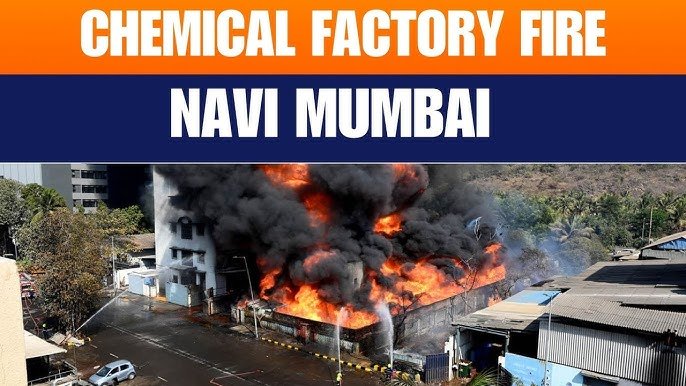

The latest chemical factory fires Navi Mumbai are the Pawane and Taloja MIDC fires. These fires are characterized by rapid spread, smoke, and massive property damage. These incidents have raised many concerns, such as industrial safety regulations, management of hazardous events, and so on.
A recent major incident occurred on 24rth January 2026, on Saturday, when a level III fire broke out at BetaChem Chemicals in the Pawane-Mahape MIDC area. The fire blazes quickly and intensifies with the chemical drum explosions spreading across the four surrounding industrial units. Fortunately, the massive fire didn’t result in any fatalities or severe injuries among workers or employees. However, it results in massive property damage towards the residential pockets of Ghansoli or Koparkhairane.
Overview of Chemical factory fire Navi Mumbai
- Casualties and injuries
Fortunately, there are no reports of severe injuries or fatalities present.
- Emergency deployment
More than 10 fire engines and specialised water tankers from regional fire departments serve the area to reduce the fire blazes.
- Containment strategy used
Firefighters deployed specialised chemical agents and water jets to control the high-intensity blazes, while heavy smoke temporarily blanketed the surrounding industrial sectors.
Talking about the industrial landscape of Navi Mumbai!
Navi Mumbai is one of the premier industrial hubs in Maharashtra, India. It hosts many Maharashtra Industrial Development Corporation zones (MIDC). Various areas like Tajola, Pawane, and Kparkhairne host a dense network of manufacturing and chemical facilities. Whenever a fire breaks out at one location, it spreads to adjacent chemical and manufacturing units, triggering level III emergencies.
Key reasons that become the cause behind Chemical factory fire Navi Mumbai!
No official reports are available that explain the cause of the disaster. But here are a few reasons that compound, leading to a fire outbreak.
- Presence of highly volatile solvents
These facilities store large quantities of raw, highly reactive solvents. But if a fire starts, these solvents act like fuel, leading to emergencies.
- Drum blasts
Due to the extreme heat at these facilities, chemical drums exploded and burst, sending burning materials into adjacent streets and neighbourhoods.
- Dense industrial layout
Factories are built in proximity to each other. Since there is limited open space, fires can spread easily.
Primary triggers include:
- Short circuit
Electrical faults due to ageing wiring are also a primary trigger of fire outbreaks. Also, poor equipment maintenance is a primary trigger of fire.
- Runaway chemical reactions
Since highly volatile and combustible solvents are stored out there, they act as a massive fuel in case of a fire, leading to a chain reaction of explosions.
- Maintenance and welding sparks
Sometimes, routine maintenance and renovations are the cause of a fire outbreak. Stray sparks can easily ignite chemical vapours or residues that can cause a fire.
Conclusion!
The fire causes structural damage and melts steel reinforcements, leading to collapsed building frames. The structural damage was huge, along with the massive environmental impact. Environmentally, the chemical inventory has produced thick and black carbon monoxide. Also, the strong seasonal winds spread the toxins and smoke throughout the nearby residential areas.