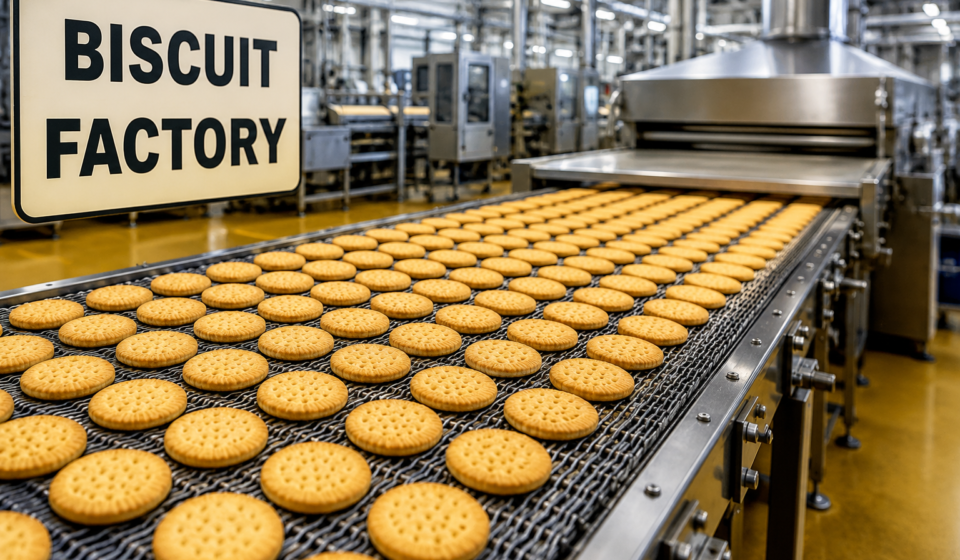

Biscuits rank higher among the most beloved snacks around the world. Most people, regardless of age or culture, like snacks, especially biscuits. If you are someone who likes biscuits and is wondering about the intricate process of biscuit-making, then you have come to the right place.
The manufacturing of biscuits is a perfect blend of science, technology and skills. It turns simple ingredients into crispy and flavorful bites. Here, you will deep-dive into the world of biscuit manufacturing, examining each stage of production to ensure consistent quality and taste.
History of the biscuit factory!
The word “biscuit” derives from the Latin Panis Biscoctus, which means twice-baked bread. Over the centuries, the industry evolved from small bakeries to automated mass production with the advent of electricity. Now, the biscuit industry has become a massive sector, producing thousands of tons of biscuits daily to meet customer demand.
A complete guide to the manufacturing journey of biscuits!
- Gathering of raw material and pre-mixing
Operations begin with raw material storage. The dry ingredients are wheat, flour, sugar and milk solids. The biscuit factory receives all the raw materials, including liquid fats, which are then sifted and quality-checked for consistency.
- Mixing of dough
Raw ingredients are mixed to form uniform, cohesive dough, which is important for consistent biscuit quality. High-speed horizontal or Sigma-arm mixers are used to blend raw materials. At this stage, the perfect temperature is important for achieving a consistent dough texture.
- Forming and moulding
Now, the dough is sent to the forming section, depending on the desired biscuit shape.
- Molding
First, the dough is pressed through engraved metal rollers to create a defined shape.
- Cutting and stamping
If one has to create hard or semi-sweet biscuits, the dough is sheeted on rollers and cut with a rotary cutter before the needles pierce it, which helps control heat expansion.
- Baking
This is one of the most important phases. Baking takes place in continuous travelling tunnel ovens. Generally, the oven tunnel extends between 40 and 80 meters. The heating oven is divided into multiple heating zones, such as conduction, convection, and radiation, where precise temperatures are maintained as required. This helps create a perfect crust, resulting in an ideal golden colour.
- Cooling
After baking, fresh biscuits are extremely fragile. They must be cooled before packaging. They have to pass through multi-tiered conveyors where ambient air gently lowers their temperature.
- Automated packaging
This is the final step of the process. High-speed machines wrap biscuits into protective slug packs and pouches. Food-grade packaging is used to safeguard biscuits against moisture, resulting in an extended shelf life.
Wrapping it all up!!!
Having the right equipment and raw materials is not complex. A biscuit factory is an immersive blend of traditional baking art and advanced industrial engineering. Precise baking, quality control and high-speed automation are used to bring consistent delivery of biscuits. The industry is evolving with high-tech, cutting-edge techniques to improve food safety and predictive maintenance.